

































































































Most BTS Engineering mechanical seals for Flygt, WILO Emu, Dreno, Zenit, Hydro-Vacuum FZ, GRUNDFOS S pumps (as well as for other submersible pumps) are available in many design variants. Let us review the most common types of materials used for seals in drainage pumps.
Corrosion-resistant cemented carbide (WCCR)
- Density (g/cm3) 14;
- Hardness (HV3) 1300;
- Elastic modulus (GPa) 600;
- Bending strength (MPa) 2600;
- Thermal conductivity coefficient (W/mK) 100;
- pH range (pH) 3–14.
Advantages:
- high strength, stiffness and toughness (excellent anti-friction properties that ensure performance under high face loads).
- good thermal conductivity (removes excess heat from friction pairs and prevents evaporation of the lubricating film on the sealing surface).
Disadvantages: WCCR is the best material for most environments, except for concentrated acids and media with a high chloride content. Depending on the material of surrounding parts, when used in seawater WCCR may be affected by galvanic corrosion.
Silicon carbide (RBSiC)
- Density (g/cm3) 3.1;
- Hardness (HV3) 2700;
- Elastic modulus (GPa) 420;
- Bending strength (MPa) 390;
- Thermal conductivity coefficient (W/mK) 100;
- pH range (pH) 0–10;
Silicon carbide for mechanical seals is used in three types: sintered, transformed, and reaction-bonded (RBSIC). BTS Engineering usually uses reaction-bonded silicon carbide in mechanical seals, since its sliding properties, wear resistance, and dimensional stability are superior.
Advantages:
- high thermal conductivity and self-lubricating capability;
- resistance to abrasive wear;
- good resistance to acidic and chloride-containing liquids.
Disadvantages: low mechanical strength and poor resistance to alkaline liquids.
Mainly due to its brittleness and sliding properties, silicon carbide still remains the second choice after cemented carbide in products and is mainly used when the corrosive properties of the liquid require it.
Aluminum oxide (Al203, CER)
- Density (g/cm3) 3.8;
- Hardness (HV3) 1500;
- Elastic modulus (GPa) 360;
- Bending strength (MPa) 300;
- Thermal conductivity coefficient (W/mK) 25;
- pH range (pH) 0–14.
Disadvantages: poorer anti-friction properties compared to cemented carbide and silicon carbide, which requires operation at lower speeds and pressures.
Graphite (CAR)
- Density (g/cm3) 2.5;
- Hardness (HV3) 100;
- Elastic modulus (GPa) 20;
- Bending strength (MPa) 80;
- Thermal conductivity coefficient (W/mK) 20.
Graphite is a relatively soft material, which makes it unsuitable for use as an external seal. However, for internal seals graphite is quite an acceptable material. Its advantage is excellent sliding and self-lubricating properties, which allow it to withstand dry running at low speeds.
Disadvantages:
- poor ability to withstand continuous operation for long periods of time;
- with large diameters, seal rings tend to swell on the surface after several thousand hours of operation, therefore carbon is usually used in small seals.
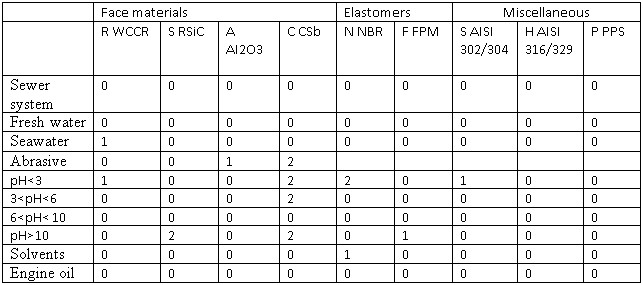
0 = No effect; 1 = Minor or moderate effect; 2 = Strong effect. Not recommended!
0 comments